Overview
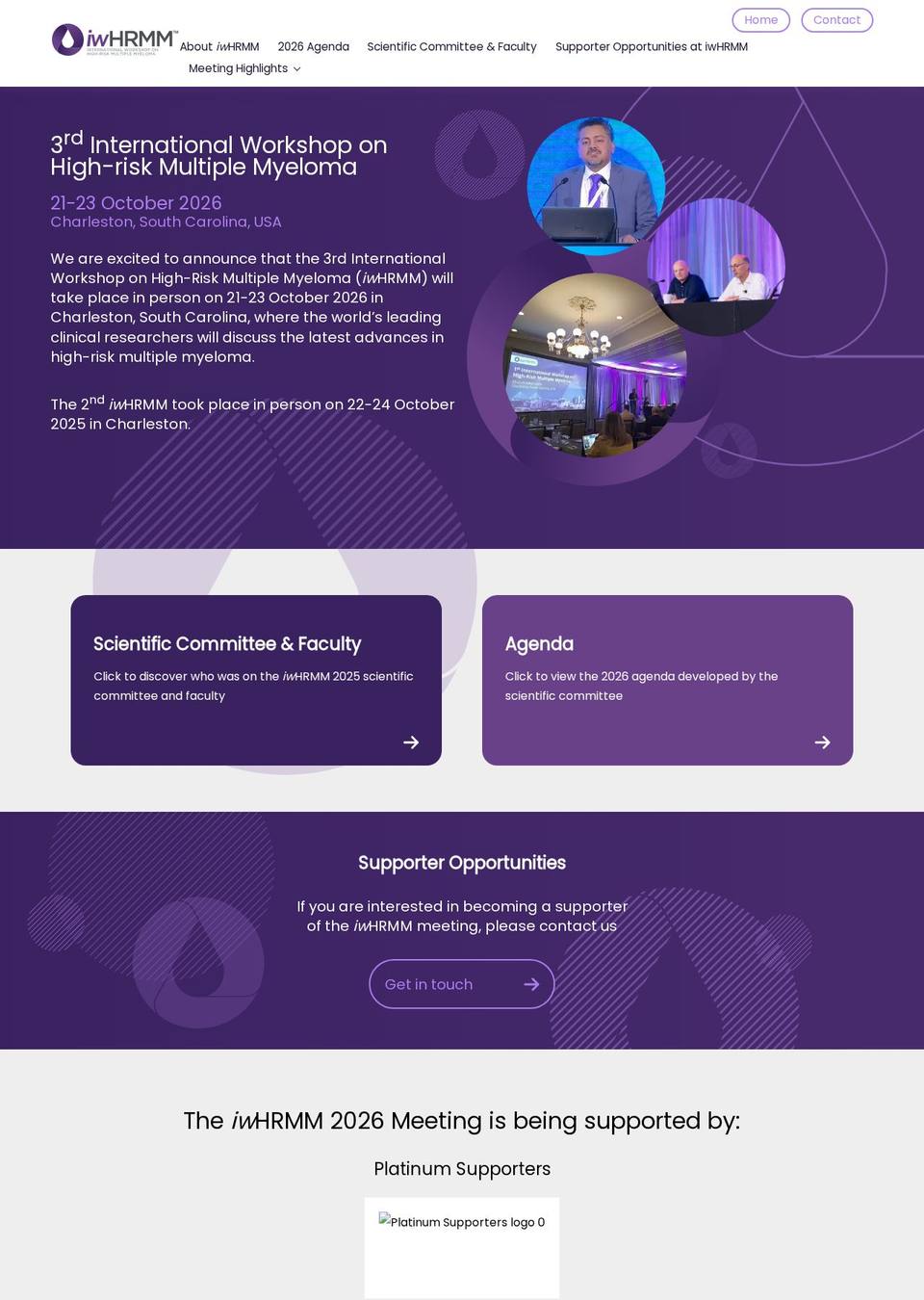
The 3rd International Workshop on High-Risk Multiple Myeloma (iwHRMM) takes place in person on 21–23 October 2026 in Charleston, South Carolina, USA, where the world's leading clinical researchers meet to discuss the latest advances in high-risk multiple myeloma. The second edition was held in Charleston on 22–24 October 2025, and the workshop has quickly established itself as the focused, discussion-driven counterpart to the large general myeloma congresses.
Unlike broad annual meetings, iwHRMM is deliberately narrow: every session addresses the subset of patients whose disease behaves aggressively — those defined by high-risk cytogenetics, extramedullary disease, plasma cell leukaemia, functional high risk and early relapse after modern quadruplet therapy.
Scientific focus
The agenda is developed by the scientific committee and typically spans:
- Defining and detecting high risk — cytogenetic and genomic risk models, refinement of the R2-ISS and mSMART frameworks, and single-cell and whole-genome approaches to risk classification
- Biology of aggressive disease — clonal evolution, resistance mechanisms, tumour microenvironment and immune escape
- Treatment strategies — risk-adapted induction, transplant and consolidation decisions, maintenance intensification
- Immunotherapy in high-risk disease — CAR-T, bispecific antibodies and the question of moving T-cell redirection earlier in the treatment course
- Measurable residual disease — MRD as an endpoint and as a decision tool in the high-risk setting
Scientific committee
Chaired by Saad Usmani (Memorial Sloan Kettering Cancer Center), with Faith Davies (NYU Grossman School of Medicine), Francesca Gay (University of Turin), Martin Kaiser (The Institute of Cancer Research & The Royal Marsden Hospital), Kylee Maclachlan (Memorial Sloan Kettering Cancer Center) and Nikhil Munshi (Dana-Farber Cancer Institute).
Faculty
The workshop draws faculty from Mayo Clinic, Dana-Farber, Memorial Sloan Kettering, Winship Cancer Institute at Emory, Moffitt, Huntsman Cancer Institute, the University of Calgary, the University of Oxford, Heidelberg Myeloma Center, Peter MacCallum Cancer Centre and the National University Cancer Institute Singapore — including Shaji Kumar, Gareth Morgan, Nizar Bahlis, Leif Bergsagel, Marta Chesi, Sham Mailankody, Francesco Maura, Simon Harrison and Sarah Gooding.
Who should attend
Haematologists and medical oncologists treating myeloma, cellular-therapy physicians, translational and genomic researchers, haematology fellows, and clinical trialists working on high-risk plasma cell disease.
Format
An in-person workshop format built around invited talks, data-driven debate and extended discussion rather than parallel tracks — attendance is intentionally kept at a scale that allows direct exchange between faculty and participants.