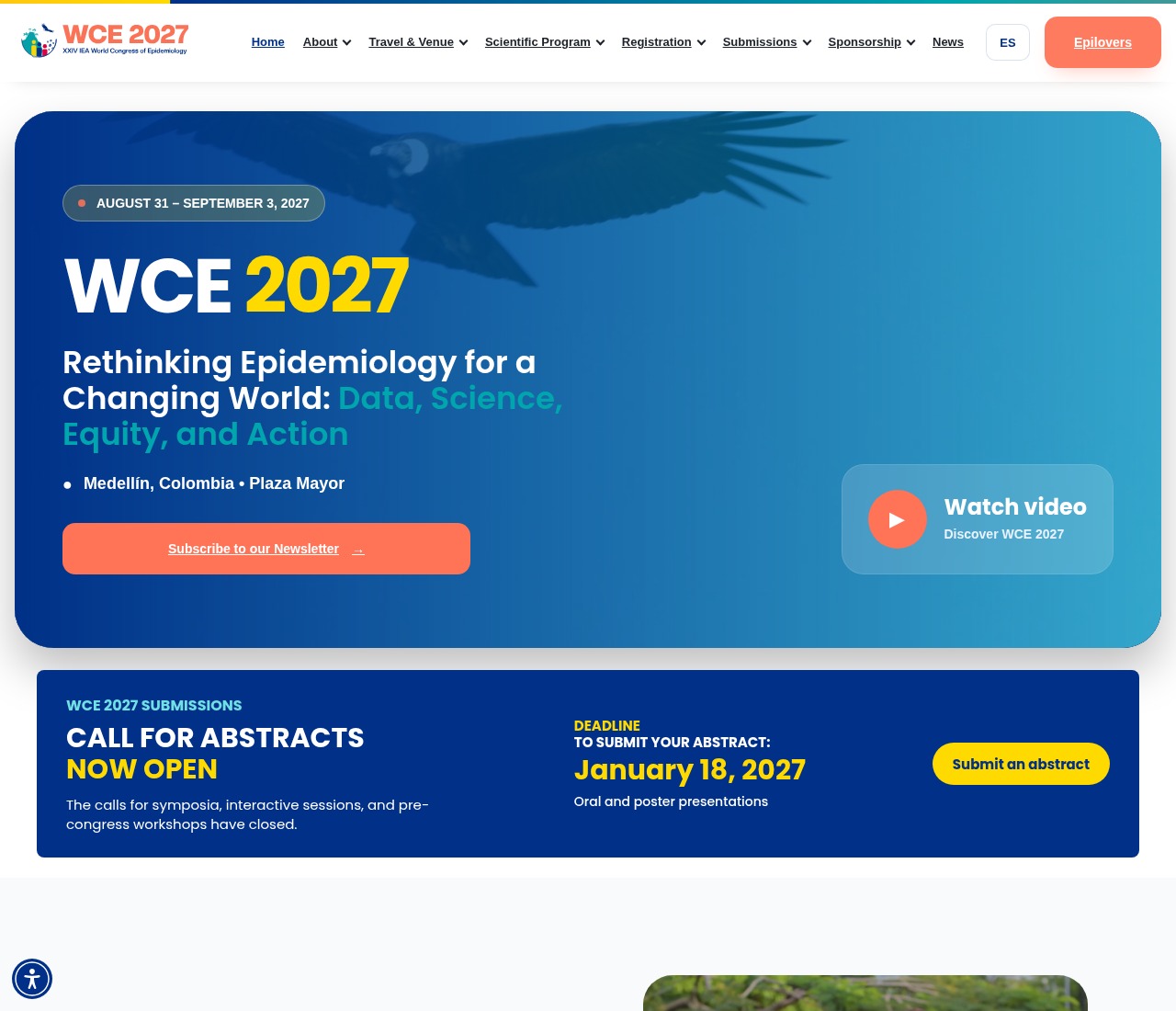
The World Congress of Epidemiology 2027 is scheduled for 31 August to 3 September 2027 in Medellín, Colombia, at Plaza Mayor. Its theme is “Rethinking Epidemiology for a Changing World: Data, Science, Equity, and Action.” The official site presents these four ideas as the pillars of the congress: data as the foundation for evidence, science as rigorous collective inquiry, equity as reducing gaps and advancing social justice, and action as translating evidence into policy and practice.
The congress invites engagement with priority questions and emerging directions in epidemiology, public policy and decision-making. It also emphasises scientific exchange and professional connections across countries and regions. The site identifies Beatriz Caicedo as congress chair, affiliated with the National School of Public Health at the University of Antioquia. Rita Elena Almanza is named co-chair and is affiliated with the Medellín Health Secretariat. Laura Andrea Rodríguez is scientific director and vice-president of Asocepic, with affiliation to the Industrial University of Santander.
The homepage separately displays organising and scientific committees. Scientific committee members shown include Adesola O. Olumide, Alexandra Restrepo Henao, Aluisio J. D. Barros, An Pan and Ana Diez Roux.
The call for abstracts is open for oral and poster presentations, with an announced deadline of 18 January 2027. The homepage states that calls for symposia, interactive sessions and pre-congress workshops have already closed.
Oral and poster presentations are the two formats named in the open abstract call. The congress framing connects the production and interpretation of data with scientific inquiry, fairer health outcomes and decisions in policy and practice. These pillars are presented together rather than as competing priorities: evidence generation supports collective scientific work, equity draws attention to inequalities and social justice, and action concerns translating findings beyond research. The meeting invitation emphasises connections across regions and countries and opportunities to exchange ideas about the future of epidemiology. Its leadership combines university-based epidemiology and public-health expertise with a local health-secretariat perspective. The setting in Medellín provides the host location for an international discussion linking research and the decisions affecting population health.
Submissions