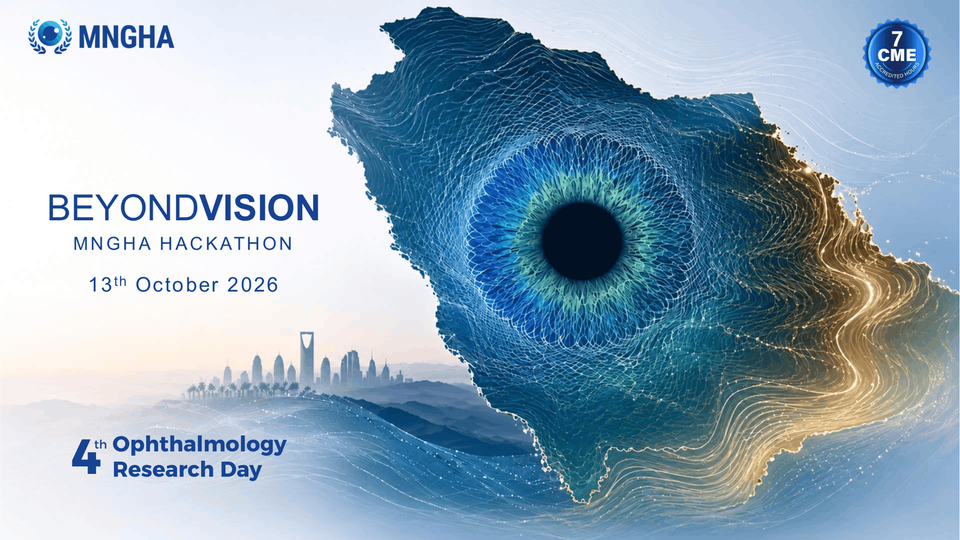
BeyondVision MNGHA Hackathon 2026
13 October 2026 · Riyadh, Saudi Arabia · In-Person · Free to participate · 7 accredited CME hours
Engineering the future of sight. BeyondVision is a clinician-led hackathon in ophthalmology and eye care hosted by the Ministry of National Guard Health Affairs (MNGHA) in collaboration with the King Abdullah International Medical Research Center (KAIMRC) and King Saud bin Abdulaziz University for Health Sciences (KSAU-HS). It is delivered as part of the 4th Ophthalmology Research Day, and this year''s theme is EYE CARE.
The question behind the programme
How do we help people see sooner, and see better? Eye disease is often silent until it is advanced. Screening capacity is finite, clinics are far from many patients, and the tools that could close that gap are frequently built without clinicians in the room. BeyondVision is designed to change that starting condition by putting ophthalmologists, engineers and designers around the same table from day one.
What teams build
Teams of two to six members develop a working concept in ophthalmology and eye care — earlier detection and triage, surgical planning, rehabilitation, or access for patients far from a specialist centre. This is not a written proposal exercise: participants are expected to leave with something that can be demonstrated. As the organisers put it, bring an idea, leave with a prototype.
Who should apply
- Ophthalmologists, residents and allied eye-care professionals who see the problem daily
- Engineers, data scientists and developers who can build
- Designers who can make a clinical tool usable under pressure
- Students and researchers with a hypothesis worth testing
The strongest teams combine several of these backgrounds. Registration is open to anyone aged 18 and over, and you can register alone and invite teammates later from your dashboard.
Mentorship and judging
Clinical mentors from MNGHA are available throughout, so assumptions can be tested against real practice rather than guessed at. Submissions are assessed by a mixed panel of clinicians and technologists against a published weighted rubric covering innovation, clinical and eye-care impact, feasibility, team capability and presentation. Review is blind, and evaluators declare any conflict of interest.
What you submit
A project title, plus Background and Prior Knowledge, a Proposed Solution and the Expected Value (each 50–200 words), and one pitch deck as a PDF or PowerPoint file up to 10 MB. Applications save automatically and any teammate can continue editing until submission. Submissions are in English, and all work must be original or appropriately licensed.
Key dates
| Milestone | Date |
|---|
| Applications open | 13 September 2026, 09:00 |
| Submission deadline | 20 September 2026, 17:30 |
| Accepted projects announced | 1 October 2026, 21:00 |
| Hackathon day | 13 October 2026, 08:00 |
Data and intellectual property
Teams may work with institutional data provided securely by the organising institutions — including imaging such as OCT scans, fundus photography and visual fields, along with tabular and synthetic clinical datasets. Participants retain their background intellectual property, while the handling of foreground IP created during the hackathon is set out in the published programme rules.
Registration
Participation is free and registration takes a few minutes on the official site. Applicants can keep refining a submission at any point before the deadline.