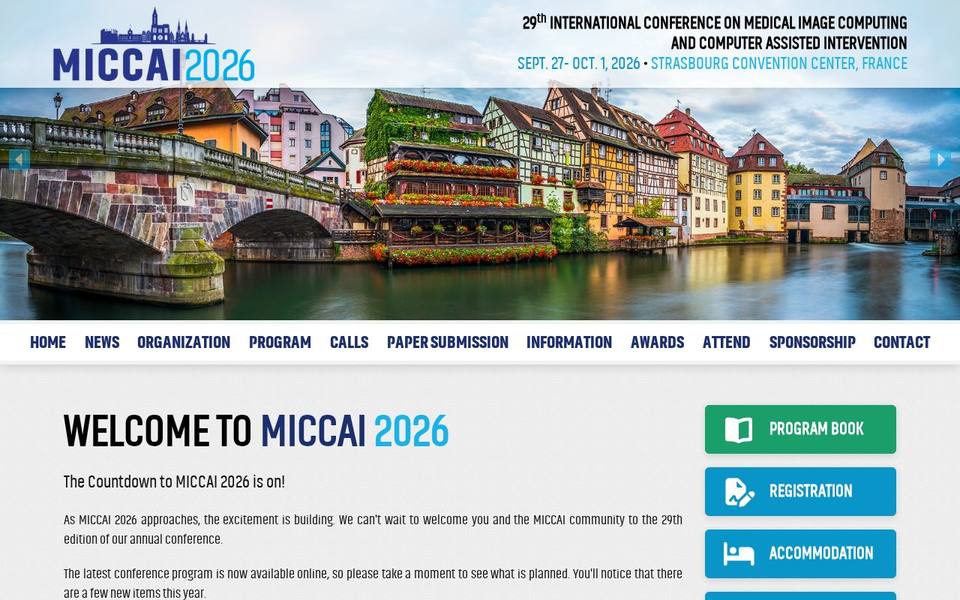
MICCAI 2026, the 29th International Conference on Medical Image Computing and Computer Assisted Intervention, runs from 27 September to 1 October 2026 at the Strasbourg Convention Center in France. MICCAI is the world's leading scientific meeting at the intersection of medical imaging, artificial intelligence and image-guided intervention.
Scale and scientific quality. The 2026 edition received a record number of submissions: 1,167 papers were accepted from 4,402 reviewed submissions — a 27% acceptance rate consistent with previous years. To showcase as much of that work as possible, organisers added a third track to the Oral and Spotlight Sessions. Review was managed by 244 Area Chairs supported by more than 3,900 reviewers.
Programme. The main conference combines keynote lectures, oral and spotlight sessions, and a very large poster programme, complemented by:
- CLINICCAI — Clinical Day, bridging methodological research and clinical adoption for practising radiologists, surgeons and interventionalists.
- Satellite events: workshops, tutorials and challenges running either side of the main conference.
- Open Data track, with its own call for papers and reviewers.
- Panels including Medical Imaging AI in 2030 and the PaRTNER panel.
- An RSNA–MICCAI joint special session, linking the imaging-informatics and radiology communities.
- MICCAI Startup Village and the RISE-MICCAI ambassador programme for early-career and low-resource-setting researchers.
A full interactive programme and the official MICCAI 2026 Program Book are published on the conference site, listing every session, keynote, workshop, tutorial and poster.
Calls and deadlines. Calls have run for papers, satellite events, workshops, tutorials, challenges, area chairs and reviewers; registration and travel grants, plus Outstanding Area Chair and Outstanding Reviewer awards, are described on the site. Proceedings are published open access.
Who should attend. Radiologists and imaging scientists working with AI, surgeons and interventionalists using image guidance and robotics, biomedical engineers, computer scientists in medical vision, and clinical researchers building or validating imaging models. For Gulf-based academic groups it is the single most efficient venue to benchmark work against the global state of the art.
Practical information — Strasbourg Convention Center, accommodation, travel to Strasbourg, French visa guidance and trip FAQs — is maintained on the official site.