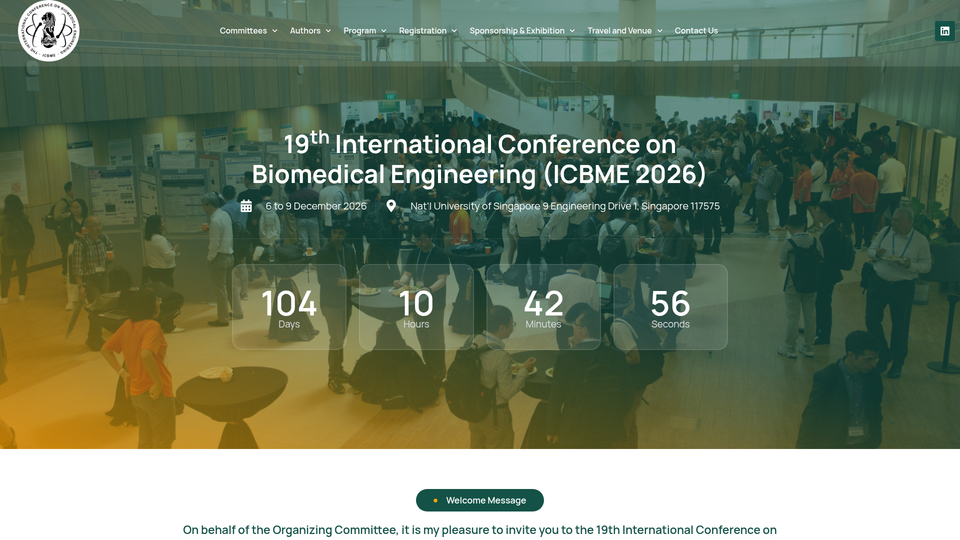
The 19th International Conference on Biomedical Engineering (ICBME 2026) takes place from 6 to 9 December 2026 at the NUS College of Design and Engineering in Singapore. Organised jointly by the National University of Singapore and the Biomedical Engineering Society (Singapore), ICBME has run since 1983 and is one of the most recognised academic conferences in biomedical engineering, drawing engineers, clinicians, scientists, industry leaders and students from across Asia-Pacific and beyond.
About the conference
ICBME 2026 is built around the theme of imagining, designing and delivering the next generation of healthcare solutions. The scientific programme spans the full spectrum of the field — from biomaterials, tissue engineering and regenerative medicine to micro- and nanotechnologies, biomedical imaging, and precision health. It also foregrounds emerging frontiers such as AI-driven healthcare, wearable technologies, medical devices, robotics, and immersive VR/AR applications, alongside clinical engineering, sustainability, ethics, entrepreneurship, and innovations supporting rehabilitation, mental well-being, healthy longevity and climate resilience.
Conference themes
- T1 — Micro-to-Macroscale Biomedical Technologies: bio-micro/nanotechnologies, microfluidics and clinical diagnostics, organ/organoid/tissue-on-chip, 3D bioprinting and additive manufacturing, biomanufacturing and cell therapy, engineering/synthetic biology.
- T2 — Biomedical Imaging, Sensing and Neuroengineering: neurotechnology, biosignals and neural interfaces, structural/functional/molecular imaging, image and signal processing.
- T3 — Therapeutics, Biomaterials & Regenerative Medicine: tissue engineering, nanomedicine, biomaterials and biointerfaces, drug and biomarker discovery, precision and targeted therapy.
- T4 — Mechanobiology: mechanobiology of disease, mechanotransduction, molecular/cell/tissue mechanics, quantitative imaging tools.
- T5 — Human Performance, Biomechanics & Wearable Technologies: biomechanics, sports science, biosensors and bioelectronics, flexible electronics and wearables.
- T6 — Robotics, Devices & Assistive Technologies: biorobotics, medical and surgical devices, rehabilitation and assistive technologies, computational modelling.
- T7 — Digital Health, AI, Data & Immersive Technologies.
Special features include a dedicated Clinical Track, special symposiums, a Women(+) in BME networking and mentorship session, a Young Investigator Award, and an industry exhibition and sponsorship programme.
Call for abstracts
Abstract submission ran from 1 May to an extended deadline of 14 July 2026, with notification of acceptance on 31 August 2026. Submissions are in English, with a 20-word title limit, full author list with affiliations, and a 200-word abstract. Every accepted abstract must be covered by at least one registered author, and one registration covers a maximum of two submissions (oral or poster).
Registration
Early-bird registration runs 1 September to 31 October 2026 (Delegate SGD 900, Student SGD 400, LMIC rate SGD 450), followed by regular rates from 1 to 21 November and onsite rates from 22 November. Delegate and LMIC fees include all sessions, lunches and breaks, the welcome reception and the gala dinner; student fees exclude the gala dinner. BES ordinary members and groups of ten or more receive a 10% discount.
Speakers
The faculty includes distinguished lecturer Joseph Wang (UC San Diego), and plenary and keynote speakers such as Wei Gao (Caltech), Cecilia Laschi (NUS), Hai-Quan Mao (Johns Hopkins), Takao Someya (University of Tokyo), Viola Vogel (ETH Zurich), Tien Yin Wong (Tsinghua University), Metin Sitti (Koç University) and Metin Akay (University of Houston).
Venue and travel
Sessions are held at the NUS College of Design and Engineering (Blk EA, 9 Engineering Drive 1, Singapore 117575), with a complimentary shuttle from Buona Vista MRT station and easy access via Singapore's MRT and bus network.