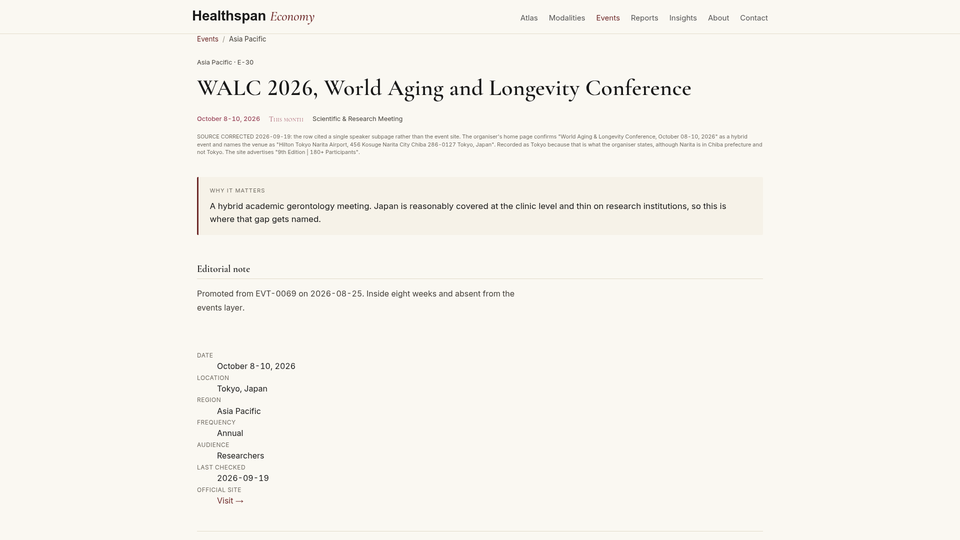
The World Aging and Longevity Conference (WALC) reaches its 9th edition with a three-day hybrid meeting at the Hilton Tokyo Narita Airport. WALC is an academic gerontology conference rather than an industry showcase: the programme is built from submitted scientific work, and the audience is predominantly researchers, academic clinicians and postgraduate trainees.
Typical WALC programming spans the biology of ageing, age-related disease, geriatric medicine and frailty, neurodegeneration and cognitive ageing, nutrition and sarcopenia, palliative and long-term care, nursing and rehabilitation for older adults, public-health responses to demographic ageing, and the social and economic dimensions of longer lives. Sessions combine invited plenaries with oral and poster presentations, and the hybrid format means delegates can present or attend online where travel is not practical.
Japan is the natural host for this conversation. It has the oldest population of any large economy and the deepest practical experience of delivering care to it, from community geriatrics to long-term care insurance. For researchers and clinicians from the Gulf, where population ageing is arriving faster than the services designed for it, the Japanese evidence base is directly relevant.
The advertised scale is deliberately modest — the organiser cites 180+ participants — which makes WALC a working meeting rather than a mass congress, with more opportunity for direct discussion with presenters than a large international congress allows. Delegates should note that although the organiser lists the venue as Tokyo, the Hilton Tokyo Narita Airport is in Narita, Chiba prefecture, adjacent to Narita International Airport rather than central Tokyo; plan accommodation and transfers accordingly.
Abstract submission, registration categories, fees and the detailed schedule are published on the conference site. Anyone intending to present should confirm submission deadlines directly with the organisers, and clinicians seeking CME or CPD recognition should verify accreditation arrangements in their own jurisdiction before registering.