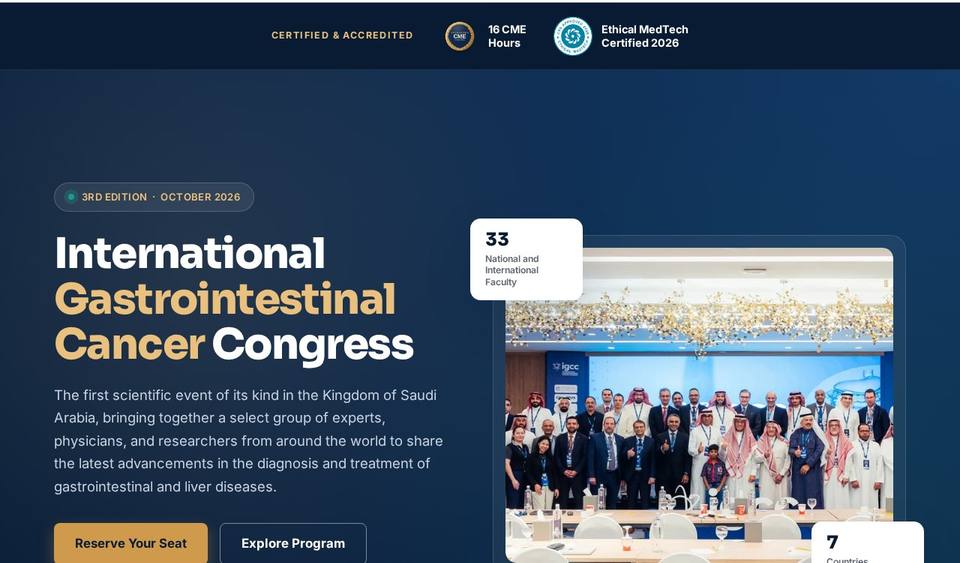
The 3rd International Gastrointestinal Cancer Congress (IGCC 2026) takes place on 2–3 October 2026 at voco Jeddah Gate in Jeddah, Saudi Arabia, and is described by its organisers as the first scientific event of its kind in the Kingdom dedicated to gastrointestinal and liver cancer.
Now in its third edition, IGCC brings together 33 national and international faculty from seven countries — the United States, Italy, the United Kingdom, Greece, Türkiye, Egypt and Saudi Arabia — including specialists from Mayo Clinic, Harvard-affiliated hospitals, Indiana University and leading European endoscopy centres. The congress is chaired by Dr. Emad S. Aljahdali, President of IGCC, with a programme leadership team that includes Dr. Muhammad K. Hasan (Center for Interventional Endoscopy), Prof. Michael B. Wallace (Mayo Clinic), Prof. Mohammad A. Al-Haddad (Indiana University) and Dr. Moamen Gabr (University of Cincinnati).
The scientific programme is organised around six organ-specific tracks — esophageal, gastric, hepatobiliary, pancreatic, colorectal and interventional endoscopy — delivered across two days with more than 35 talks and debates. Sessions pair practical endoscopic technique with oncology decision-making: Barrett's surveillance and risk stratification, endoscopic submucosal dissection for early cancers, esophageal stenting for malignant dysphagia, gastric intestinal metaplasia surveillance, gastric GIST management, HCC surveillance in cirrhosis, EUS-guided liver biopsy, digital cholangioscopy in indeterminate biliary strictures, lumen-apposing metal stents, intraductal radiofrequency ablation for cholangiocarcinoma and endoscopic management of ampullary neoplasms.
A distinguishing feature of IGCC is its five moderated live debates on questions that remain genuinely unresolved in practice — ESD versus surgery for early gastric cancer beyond absolute criteria, watch-and-wait in rectal cancer, ERCP versus EUS-guided biliary drainage in hilar cholangiocarcinoma, and the management of high-risk T1b esophageal adenocarcinoma after endoscopic resection. Each debate names a proposer and opponents drawn from the faculty, with dedicated question-and-answer time.
Emerging technology runs throughout the agenda, including AI-assisted lesion detection, magnetically controlled capsule endoscopy, third-space endoscopy and endoscopic full-thickness resection. A sponsored industry symposium runs over the lunch break alongside an exhibition, and structured networking time is built into both days.
IGCC 2026 is accredited for 16 CME hours, with credit certificates issued to registered delegates after the congress. The working language is English. The congress is relevant to gastroenterologists, advanced and interventional endoscopists, medical and surgical oncologists, hepatologists, GI surgeons, radiologists, pathologists, fellows and trainees working in gastrointestinal and liver cancer care across Saudi Arabia and the wider region.