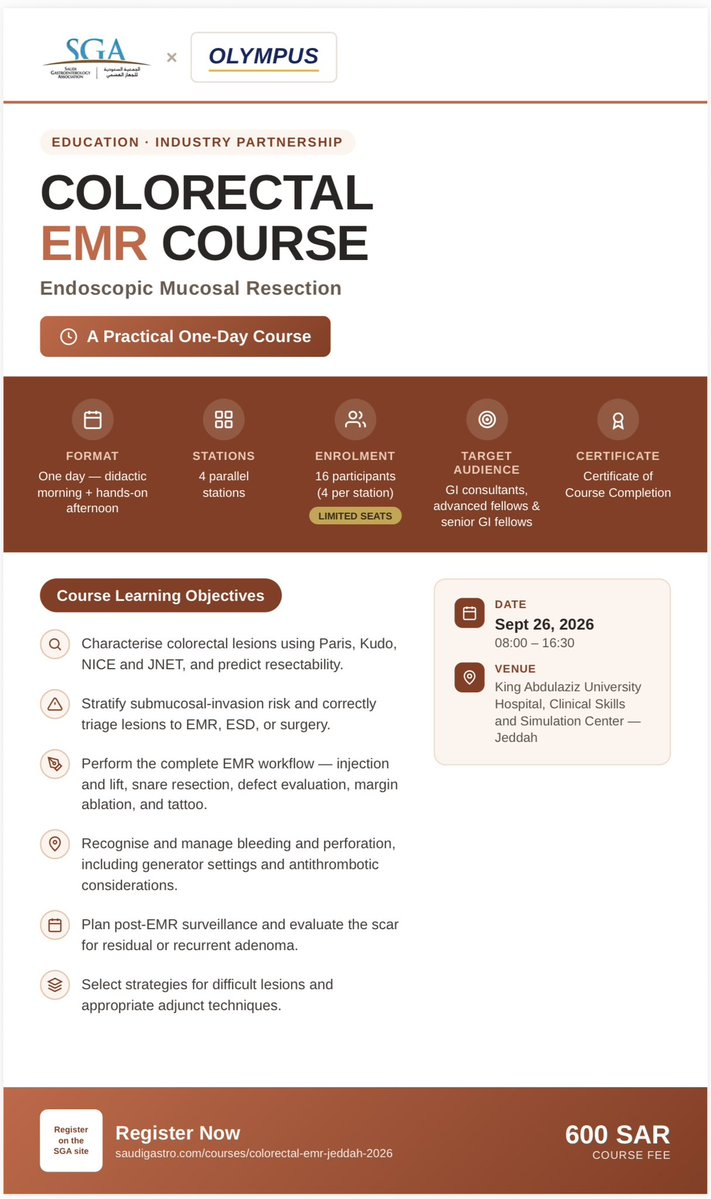
The SGA Colorectal EMR Course is a practical, one-day programme developed by the Saudi Gastroenterology Association in collaboration with Olympus, held on Saturday 26 September 2026 from 08:00 to 16:30 at the Clinical Skills and Simulation Center, King Abdulaziz University Hospital, Jeddah.
Endoscopic Mucosal Resection is now a core skill in modern colorectal practice, offering outcomes comparable to surgery at significantly lower risk and cost. With national screening programmes detecting more large and complex polyps, structured competency-based EMR training has become essential rather than optional. The course answers that need with a focused didactic morning followed by an intensive hands-on afternoon across four parallel simulation stations. Enrolment is capped at 16 participants, four per station, so that every trainee works under close faculty supervision and receives individual feedback.
By the end of the day participants should be able to characterise colorectal lesions using the Paris, Kudo, NICE and JNET systems and predict resectability; stratify submucosal-invasion risk and triage lesions correctly to EMR, ESD or surgery; perform the complete EMR workflow from injection and lift through snare resection, defect evaluation, margin ablation and tattoo; recognise and manage bleeding and perforation including generator settings and antithrombotic considerations; plan post-EMR surveillance and evaluate the scar for residual or recurrent adenoma; and select strategies for difficult lesions along with the appropriate adjunct techniques.
The supporting curriculum runs to 22 modules across six units — foundations and the EMR imperative, lesion assessment before cutting, the science of cutting, the procedure itself, complex scenarios, and outcomes and quality. Topics include optical diagnosis, predicting submucosal invasion, electrosurgery principles, accessories and devices, submucosal injection, standard and underwater EMR, piecemeal strategy for large lesions, margin assessment and ablation, complex polyps at the ileocaecal valve and appendiceal orifice, hybrid techniques, when not to EMR, bleeding and perforation management, post-polypectomy coagulation syndrome, histopathology reporting using Haggitt and Kikuchi, surveillance intervals, registry quality metrics, and non-technical skills and consent. The curriculum is benchmarked against the JAG UK and ESGE frameworks, with Bloom-tagged outcomes, case-based reasoning and self-assessment questions in every module.
Hands-on training is the centre of the day: four parallel simulation stations in groups of four, supervised directly by SGA faculty and Olympus clinical specialists. Participants receive a Certificate of Course Completion from the Saudi Gastroenterology Association.
The course is aimed at GI consultants, advanced endoscopy fellows and senior GI fellows — clinicians who already perform colonoscopy and want a structured route to competence in advanced polypectomy rather than learning it case by case. The fee is SAR 600 and registration is through the SGA website, where the current seat count is displayed. Places are strictly limited by station capacity, so early booking matters.
A second edition of the same course runs in Riyadh on 30 October 2026 at King Khalid University Hospital, KSUMC, for those who cannot travel to Jeddah.